

What a drip control zone kit actually does
Drip emitters are rated for 15 to 30 PSI at the line. Residential mainline pressure runs 40 to 80 PSI. Wire a drip lateral directly to the mainline and the emitters either pop off, throw irregular flow, or clog from sediment that a spray head would have flushed through. A drip control zone kit is the device that sits between the mainline and the drip lateral and fixes all three problems in one pre-assembled body.
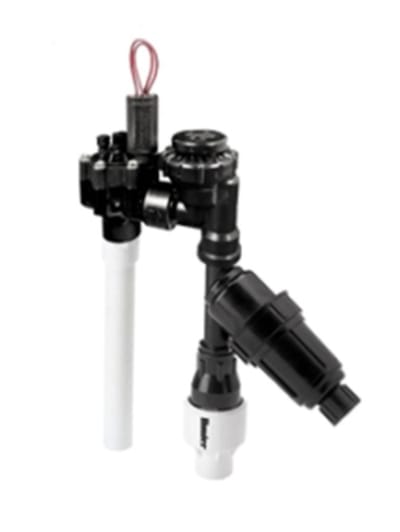
Three jobs in one assembly:
- Shut-off. Either an electric solenoid (controller-driven, opens when the station calls) or a manual anti-siphon valve (operated at the bibb).
- Pressure regulation. A fixed regulator that drops the inlet down to a stable 25 or 40 PSI at the outlet, matching what drip line is rated to handle.
- Filtration. A 200-mesh basket strainer that catches grit before it reaches the emitters. Per Hunter's ACZ literature, the screen is designed to be pulled and rinsed every six months on municipal supply, more often on well water.
The full kit catalog at Total Sprinkler sits on the Control Zones & Conversion Kits category. This guide explains which kit to pick and how to install it.
How to choose the right kit
Four specs decide which kit fits the zone. Work through them in order; each one narrows the choice further.
1. Mainline pressure at the source
Measure static mainline pressure with a gauge threaded onto a hose bibb. Residential systems usually fall between 40 and 80 PSI. If the reading is at the high end of that band, or the zone sits downhill of the source, choose a 25 PSI regulator — there is enough headroom that even a long lateral arrives at drip pressure. If the reading is at the low end, or the zone runs uphill, the 40 PSI body buys back the elevation and pipe-friction losses upstream of the lateral. The K-Rain kit's 30 PSI option splits the difference for moderate-pressure systems.
2. Zone flow demand (GPM)
Sum the published flow of every emitter on the zone and divide by 60 to get GPM. Most residential drip zones land between 0.5 and 5 GPM, which every kit listed below handles. Above 10 GPM, drop the low-flow variants (the LF bodies hold regulation down to about 0.2 GPM but choke at the top of their range). The standard non-LF body is the right call for zones with a lot of emitters or above 5 GPM.
3. Valve type
Electric solenoid for any zone the controller turns on. Manual anti-siphon for hand-operated bibb installs or above-grade backflow situations where local code requires an ASV instead of an in-ground vacuum breaker. Hunter's PCZ and ICZ kits are both controller-driven (PGV solenoid on PCZ, the heavier ICV solenoid on ICZ). The Hunter ACZ family and the Rain Bird XACZ both carry an integrated anti-siphon valve and can be hand-operated.
4. Thread size
3/4" FIPT for the smaller residential mainlines and most retrofits onto a hose-bibb tee. 1" for new construction and any zone that needs the larger valve port to clear higher GPM without throttling. The Hunter ACZ family ships in 3/4"; the Hunter PCZ, Hunter ICZ, Rain Bird XACZ, and K-Rain KP7001 families ship in 1". Match the size to what the mainline carries.
Hunter ACZ vs PCZ vs ICZ vs K-Rain at a glance
All four families do the same three jobs but split on valve type, thread size, and target flow. Specs below come from Hunter and K-Rain product literature plus the TS product detail pages for each kit.
| Family | Thread | Outlet PSI | Filter | Valve | Solenoid included | Price band |
|---|---|---|---|---|---|---|
| Hunter ACZ (3/4") | 3/4" FIPT | 25 or 40 PSI | 200-mesh basket | Anti-siphon (manual) | No (no controller required) | $72 to $76 |
| Hunter PCZ (1") | 1" x 3/4" | 25 or 40 PSI | 200-mesh basket | PGV electric | Yes | $84 |
| Hunter ICZ (1" LF) | 1" | 25 or 40 PSI | 200-mesh basket | ICV electric (commercial-grade) | Yes | $156 to $169 |
| Rain Bird XACZ (1" ASV) | 1" | Per Rain Bird PR + RBY filter spec | RBY filter | ASVF anti-siphon | Yes (ASVF integrated valve) | $71 |
| K-Rain KP7001 kit | 1" | 30 or 40 PSI | Filter included | PRO 100 electric | Yes | $72 |
The Hunter ACZ wins on cost and simplicity for any zone the homeowner turns on by hand. The PCZ is the standard 1" controller-driven kit and fits most residential systems. The ICZ steps up to a heavier valve body: the right call for any zone the system runs year-round or on a tight watering window where a failed valve would burn out the planting. The Rain Bird XACZ is the 1" ASV alternative when the install needs an above-grade anti-siphon. The K-Rain kit pairs the company's PRO 100 valve with a filter and regulator at the lower end of the price band, with a 30 PSI option that pairs cleanly with most inline drip tubing.
Step-by-step install
Same procedure for every kit family; only the valve type and thread size change. Allow about an hour for a fresh install, less for a retrofit onto an existing tee.

1. T off the mainline
Cut the mainline cleanly with a PVC saw. Set a slip x slip x FIPT tee where the branch will rise. Glue both slip ends with PVC primer first, then PVC cement; hold for thirty seconds. The mainline is now open to the new branch.
2. Transition fitting + riser
Thread a male adapter into the tee branch with PTFE tape, two wraps in the same direction the thread tightens. Run a short riser (Schedule 80 nipple or a flexible swing-pipe assembly) up to where the kit body will sit, then a female slip-by-thread adapter on top to receive the kit inlet.
3. Thread on the kit body
Two wraps of PTFE on the kit inlet. Hand-tight first, then a half turn with a wrench on the kit body's hex flat. Stop the moment you feel real resistance. Over-torque cracks the plastic body where the regulator boss screws in, and the failure shows up two months later as a slow weep that will not seal no matter how much PTFE you add on the retry.
4. Wire the solenoid (electric kits)
For PCZ, ICZ, and K-Rain electric kits: one solenoid lead goes to the controller's common (white) wire; the other goes to the station wire for this zone. Use waterproof wire connectors with gel-filled caps, not bare wire nuts buried under a valve box. Wire to the station terminal, not the master-valve terminal — wiring the kit to MV means it only opens when another zone runs, and the drip schedule never executes on its own.
5. Connect the drip lateral
A barbed compression adapter at the kit outlet transitions to 1/2" or 1/4" drip tubing. The kit's outlet is a 3/4" or 1" thread depending on family; match the compression fitting to that thread. Browse the run sizes that pair with each kit outlet on the Inline Drip Tubing category.
6. Pressurize and verify
Open the master valve and run the new zone from the controller (or open the ACZ manual bleed). Walk the lateral. The first 30 seconds will show air burping through the emitters. After that, every emitter should drip at its published rate. If the lateral never pressurizes, the regulator is cinched too tight against its seat or the filter basket is set against its O-ring at the wrong angle. Pull the strainer, re-seat, and re-run.
Common install mistakes (and what they look like in the field)
- Over-tightening the threads. The kit body is reinforced plastic, not brass. Two PTFE wraps plus hand-tight plus a half turn is the spec. Crank past that and you crack the body at the regulator boss; the symptom is a slow weep that returns two days after every re-seal attempt.
- Skipping or losing the filter screen. The basket strainer is the cheapest part of the kit and the only thing between municipal grit and a $200 row of emitters. Reinstall it every time you service the body.
- Wrong PSI rating for the source. A 40 PSI kit on a 35 PSI mainline never reaches regulation; the lateral runs at unregulated pressure. A 25 PSI kit on an 80 PSI mainline regulates fine, but every PSI of drop above 25 happens across the kit's own regulator, which shortens its service life. Match the regulator to the static source.
- Wired to the master-valve terminal. The kit opens only when a separate zone calls; the drip schedule never executes on its own. Trace the station wires at the controller back-plate before tightening any connector.
Featured drip control zone kits in stock
- Hunter ACZ-075-25 (3/4" with 25 PSI regulator). The 3/4" anti-siphon kit for hand-operated drip zones, 0.5 to 15 GPM.
- Hunter ACZ-075-40 (3/4" with 40 PSI regulator). Same 3/4" body for low-static-pressure or uphill drip runs.
- Hunter PCZ-101-25 (1" PGV electric, 25 PSI). The 1" controller-driven kit for standard residential drip zones, 0.5 to 15 GPM.
- Hunter PCZ-101-40 (1" PGV electric, 40 PSI). Same body on the 40 PSI regulator for low-pressure or uphill 1" runs.
- Hunter ICZ-101-25-LF (1" ICV low-flow, 25 PSI). The heavier ICV solenoid plus a low-flow regulator, sized for tight emitter rows that won't tolerate flow swings.
- Rain Bird XACZ100PRF (1" ASVF + PR + RBY filter). Rain Bird's 1" anti-siphon kit, the alternative to the Hunter ACZ at the larger thread size.
- K-Rain KP7001-FPR30 (30 PSI) and KP7001-FPR40 (40 PSI). K-Rain's PRO 100-valve kits at both common regulator settings.
Replacement parts and retrofit options
When the filter screen finally gives out, the NDS 3/4" Drip Filter is a one-piece replacement that threads onto any 3/4" FIPT outlet. For retrofits where the system already has a working valve and only needs regulation downstream, the Hunter Accu Sync Adjustable 20 to 100 PSI regulator threads to the existing valve outlet and locks the downstream pressure without replacing the body.
Keep going
For the full kit catalog at both 3/4" and 1" sizes, browse the Control Zones & Conversion Kits category. For the drip line that runs downstream of the kit, see Inline Drip Tubing and the broader Drip Irrigation category.