

Drip tubing sizing comes down to three numbers
Every inline drip tubing layout is a choice on three axes: emitter GPH (how much water each outlet delivers per hour), emitter spacing (how far apart the outlets sit on the tubing), and max run length (how many feet of tubing you can chain from one zone valve before pressure at the far end falls below the dripline's design point). Get any one of those wrong and the bed at the end of the line underwaters while the bed at the start drowns.
Soil type sets spacing. Plant water demand sets GPH. The dripline manufacturer's pressure-compensating range sets the run-length cap. The sections below walk each axis in order; read top-to-bottom, end with a spec'd zone.
Emitter spacing — match it to your soil's wetting cone
Water leaving a drip emitter doesn't sink straight down. It spreads sideways as it falls, forming a roughly conical wet zone under the soil surface. The width of that cone is set by how fast the soil drains. Sandy soils drain fast, so water races down and sideways spread is narrow. Clay soils drain slowly, so water lingers in the upper profile and spreads broadly. Loam sits in the middle.
Spacing tighter than the wetting cone width buys nothing (the cones overlap and you've paid for emitters you don't need). Spacing wider than the cone width leaves dry stripes between rows. The published rule of thumb:
| Soil type | Recommended emitter spacing | Why |
|---|---|---|
| Sandy | 9–12″ | Narrow vertical wetting cone; needs more outlets per linear foot to avoid dry gaps |
| Loam (most residential beds) | 12″ (standard) to 18″ | Moderate lateral spread; 12″ for shallow-rooted plantings, 18″ for established shrubs |
| Clay | 18–24″ | Broad horizontal wetting cone; tighter spacing puddles and runs off |
If you don't know your soil type, do the ribbon test: take a moist handful, squeeze it into a ball, and roll a 1″-diameter ribbon between your fingers. Sand crumbles before forming a ribbon; loam holds a ribbon up to about an inch before breaking; clay forms a smooth ribbon of two inches or more. Two minutes of testing saves a season of replacement plantings.
Emitter GPH and plant water demand
GPH (gallons per hour) per emitter is the dial that controls how long the zone needs to run. Higher GPH means a shorter run time delivers the same volume of water. The constraint: every line of dripline runs on the same controller program, so the GPH has to match the slowest-drinking plant on the line. Mix high-demand annuals with low-demand drought-tolerant shrubs on one zone and the shrubs will rot.
| Planting | Recommended GPH | Typical run time per cycle |
|---|---|---|
| Vegetable beds, annual flowers | 0.9–1.0 GPH | 30–45 min, 3–5×/week in summer |
| Established shrubs, perennial borders | 0.6–0.9 GPH | 45–60 min, 2–3×/week |
| Drought-tolerant natives, xeriscape | 0.6 GPH | 60 min, 1–2×/week |
| Trees (5″+ canopy) | Dedicated 1.0+ GPH point-source emitters, OR a loop of 0.9 GPH dripline around the dripline of the canopy | 60–90 min, 1×/week deep watering |
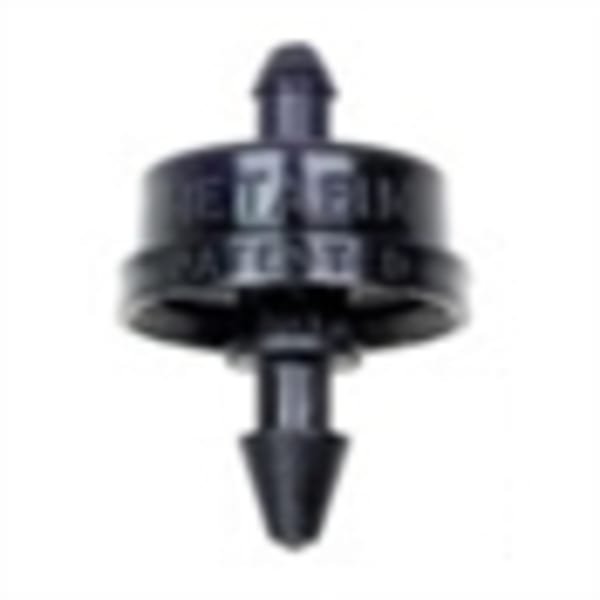
For trees specifically: a single line of 0.9 GPH dripline running past the trunk delivers nowhere near enough water to a mature canopy. Either ring the dripline of the tree's canopy (the perimeter of the leaf coverage) with a loop of 0.9 GPH dripline, or install three to six dedicated 1.0 GPH point-source emitters spaced around the dripline. Point-source emitters like the Netafim Woodpecker 1.0 GPH (NET-58-1003) are the standard tree-watering choice.
Run length
Pressure-compensating dripline holds its rated GPH across an operating pressure band (typically 7–60 PSI for Netafim Techline CV and Rain Bird XFS-CV). Past the upper end of that band the emitters meter tighter; below the lower end they meter under. Max run length is the longest stretch of tubing where the far end still sits inside the band given inlet pressure and friction loss along the run.

Per Netafim's Techline CV design guide, with published values for half-inch tubing at 40 PSI inlet, longer spacing buys longer allowable runs because fewer outlets per foot mean less cumulative GPH draw per foot of tubing:
| Tubing | Emitter GPH | Spacing | Max run from one inlet |
|---|---|---|---|
| 1/2″ Techline CV | 0.6 GPH | 12″ | ~330 ft |
| 1/2″ Techline CV | 0.6 GPH | 18″ | ~440 ft |
Higher-GPH (0.9 GPH) configurations cap shorter because each foot of tubing draws more cumulative flow. Pull the specific number for your install from Netafim's published Techline CV design guide, or Rain Bird's design guide for XFS-CV; both manufacturers post current PDFs on their product support pages.
If your bed needs more linear footage than the table allows, split the zone with a tee (a 17mm insert tee (NET-58-1057) works for half-inch tubing) and feed two shorter runs from a single inlet. Each branch counts independently against the max-run number, so a 600-ft bed splits cleanly into two 300-ft runs of 0.6 GPH at 12″ spacing.
Pressure-compensating vs. non-PC
Pressure-compensating dripline (Netafim Techline CV, Rain Bird XFS-CV) holds rated GPH across a wide inlet-pressure band, so emitters at the high point of a sloped run deliver the same volume as emitters at the low point. Non-PC dripline meters by simple orifice flow, so emitter GPH drops as pressure drops. The decision rule:
- Use PC dripline on any slope greater than about 5 ft of elevation across the run, on any run within 10% of the max-run table figure, and on any zone where uniformity matters (vegetable beds, formal plantings). PC is the default for new installs.
- Use non-PC dripline on short (under 100 ft), flat, residential beds where the cost savings show up and the uniformity penalty is negligible.
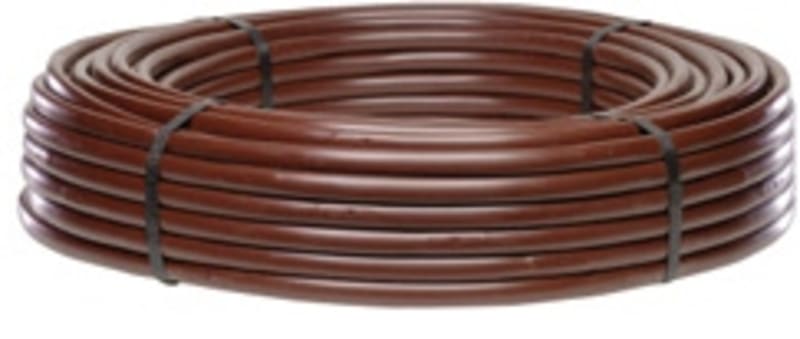
The standard residential PC choices on Total Sprinkler, root-resistant and reclaimed-water-rated:
- Netafim Techline CV 0.6 GPH, 18″ spacing, 250 ft coil (NET-58-1077). The most-stocked low-flow option, best fit for shrub borders on loamy soil.
- Netafim Techline CV 0.6 GPH, 12″ spacing, 250 ft coil (NET-58-1074). Same 0.6 GPH for sandier soils where 18″ leaves gaps.
- Netafim Techline CV 0.9 GPH, 12″ spacing, 100 ft coil (NET-58-1083). Higher flow for raised vegetable beds and annual borders.
- Rain Bird XFS-CV 0.6 GPH, 12″ spacing, 500 ft Gold coil (RBD-58-2472). Reclaimed-water-rated long coil for larger zones.
- Rain Bird XFS-CV 0.9 GPH, 12″ spacing, 500 ft coil (RBD-58-2466). High-flow option in a 500-ft coil.
- Rain Bird Xeri-Flex blank dripline, 500 ft (RBD-58-9658). Unmetered tubing for the supply line feeding the emitter section.
Fittings to close the loop: a Netafim insert coupling (NET-58-1061) joins two coils end-to-end. A 3/4″ male adapter (NET-58-1058) ties dripline to standard PVC supply. A Netafim shut-off valve (NET-58-1097) lets you isolate a zone for repair without killing the whole controller program.
Next step
Once you've picked GPH, spacing, and a run plan, the next decision is the control zone that feeds the dripline: the regulator, filter, and valve assembly that sits between your supply line and the first foot of Techline. Our Drip Control Zone Kit Guide covers that side; ship date in a separate cycle.
Browse the full Inline Drip Tubing category for every active coil, or step up a level to Drip Irrigation for filters, emitters, regulators, and the rest of the build kit.