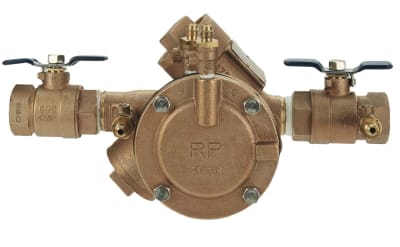

Any irrigation system tied to a potable water supply needs a backflow preventer between the tap and the first sprinkler valve. When supply pressure drops below the pressure sitting in the irrigation line, contaminated water gets siphoned back toward the drinking-water system. A fire hydrant opens. A main breaks. A heavy-draw appliance fires upstream. Three device classes stop that event, and each one maps to a different hazard rating and different code requirements.
Local code is the binding answer. Most US municipalities follow AWWA M14 (Recommended Practice for Backflow Prevention and Cross-Connection Control) or a local adaptation of it. The water utility or plumbing inspector decides which device class your install needs. This guide gives you the vocabulary so you arrive at the permit conversation ready. The full lineup sits on the Backflow Preventers category.
- AVB (atmospheric vacuum breaker). The simplest and cheapest. Narrowest install rules. Common as built-in protection on anti-siphon valves for low-hazard residential zones.
- PVB (pressure vacuum breaker). The standard residential device for systems that do not qualify as low-hazard.
- RPZ (reduced pressure zone assembly). Highest protection. Required for high-hazard installs and most commercial irrigation. Annual certified testing in most jurisdictions.
- Double-check assembly. For low-hazard backflow only.
What each backflow preventer does
Atmospheric vacuum breaker (AVB)
An AVB is the simplest backflow device. An air inlet opens to atmosphere when upstream pressure drops below atmospheric. Air flows in, a column of contaminated water cannot rise past it, and siphoning is interrupted. The mechanism works only on a vacuum event, so an AVB cannot sit downstream of any shut-off valve. Closing the valve traps pressure at the AVB and defeats the air inlet. It also has to sit above the highest downstream outlet, with code-specified clearance over every sprinkler head, drip emitter, and hose bib in the zone. Local code typically calls for at least 6 inches above the highest head. Verify with your jurisdiction.
Most residential lawn-irrigation builds use an AVB built into each zone valve rather than a stand-alone device. Hunter's PGV-ASV and Rain Bird's ASVF lines are AVB-integrated zone valves, with the anti-siphon protection at the top of each valve body. AVB-integrated valves are accepted in many low-hazard residential jurisdictions. Check the code before specifying them. The Valves category lists every Hunter PGV-ASV and Rain Bird ASVF anti-siphon valve in stock.
Pressure vacuum breaker (PVB)
A PVB works under continuous downstream pressure, which is the constraint an AVB cannot satisfy. A single spring-loaded check valve sits in the body, with an air inlet above it. When supply pressure drops, the check closes and the air inlet opens to atmosphere. Same protection mechanism as the AVB, but the device can sit downstream of shut-off valves and at the head of a zoned system with constant pressure on the lateral side. PVBs are the standard residential backflow device above the AVB tier.
Install constraint: the PVB body has to sit a code-specified distance above the highest downstream outlet. 12 inches above the highest sprinkler head is a common figure. The actual number varies by jurisdiction. The Febco 765 line is the dominant residential PVB. Apollo's PVB4A series is the common alternative.
Reduced pressure zone assembly (RPZ)
An RPZ is the highest-protection backflow device. The body holds two independent spring-loaded check valves with a differential pressure-relief valve in the chamber between them. If either check fails or upstream pressure drops, the relief valve opens and dumps the contaminated zone water to atmosphere through a vent at the base of the body. The double-check redundancy and the active relief mechanism catch failure modes a single-check device cannot. The relief valve also gives a visible failure signal. Water at the vent means the device needs service.
RPZs are required for high-hazard installs: fertilizer-injected irrigation, reclaimed-water hookups, commercial irrigation tied to a potable main, and any install the local code classifies as a Class 5 or above cross-connection. The Febco 825Y line is the volume residential and light-commercial RPZ. Apollo's RP4A and Conbraco's RP4AN cover the same profile. All three are stocked in lead-free configurations to meet the post-2014 Safe Drinking Water Act sale requirement.
Which device your install needs
Two inputs drive the decision: local code and the hazard class of the install. Code is the binding answer. Hazard class is the framework most codes use to assign device requirements, so understanding it lets you predict what the code will say before you call. AWWA M14 sorts cross-connections into low, moderate, and high hazard.
- Low hazard. A simple residential lawn zone with no fertilizer injection, no chemical dosing, no auxiliary water source (well or rain barrel) tied in. The contaminant risk is soil percolate and turf bacteria. AVB-integrated valves are commonly accepted.
- Moderate hazard. Residential or light-commercial irrigation with multiple zones, an auxiliary supply, or any in-line chemical the AVB cannot isolate. A dedicated PVB at the irrigation tap is the standard answer.
- High hazard. Any install with fertilizer injection (a fertigation head), reclaimed-water hookups, commercial-scale irrigation, or a regulated property type (school grounds, public park, food-service exterior). RPZ is required.
Install requirements per device class
Each device class carries its own clearance, drainage, and freeze-protection rules. Hard numbers vary by jurisdiction. The categories below name the constraint and the typical figure so you know what to look up.
- Height above highest outlet. AVBs and PVBs must sit above every downstream emitter so a vacuum event cannot draw water past the air inlet. AVB minimums commonly land at 6 inches above the highest sprinkler head. PVBs commonly at 12 inches. RPZs do not have a height-above-outlet requirement, but do have a minimum height above grade (commonly 12 inches) so the relief valve can drain freely.
- Drainage at the RPZ relief valve. The relief vent at the base of an RPZ has to drain to grade with no possibility of submergence. A box, cover, or freeze enclosure has to include an air gap at the relief vent. Submerged or restricted vents cause the relief mechanism to backpressure and either fail or cause property damage when it actuates.
- Freeze protection. Any device mounted above grade in a freezing climate needs insulation through the winter or a manual winterization. Insulated covers rated for the device size are the standard answer in zones 4 and colder. PVBs and RPZs are typically more freeze-sensitive than AVB-integrated valves because the mechanism sits in a single exposed body.
- Access for testing. RPZ test cocks and PVB shut-offs need clear access for the annual tester. A device buried in a planter box without a hinged cover is the most common code violation a tester writes up.
Most US jurisdictions require an annual certified test on every installed RPZ. PVB testing is required in some jurisdictions and not in others. AVB testing is uncommon, since the device has no moving parts that need calibration. The test is performed by a backflow tester certified by the state. TS sells the devices, not the testing service. For the annual test, the local water utility's cross-connection program maintains a list of certified testers in your area.
Febco, Apollo, Watts, and Conbraco, shipped fast
Anti-siphon valves for low-hazard lawns, Febco 765 PVBs at the irrigation tap, and lead-free Febco 825Y RPZs for fertigation and commercial installs.